Issue 22 · Meaning loss
A Policy Forms Library Is a Control System, Not a Document Repository
A forms library that cannot prove what text attached to a policy term cannot support a safe migration, a claims answer, or a renewal change. The technology problem is preserving contract identity, not scanning more PDFs.
One system
policy forms
The other
policies
The policy administration system and the forms library meet at issuance, where a declarations schedule must prove which operative text the system is entitled to execute.
The form number in the footer is not a filing label; it is part of the primary key for a promise that may outlive every system that printed it.
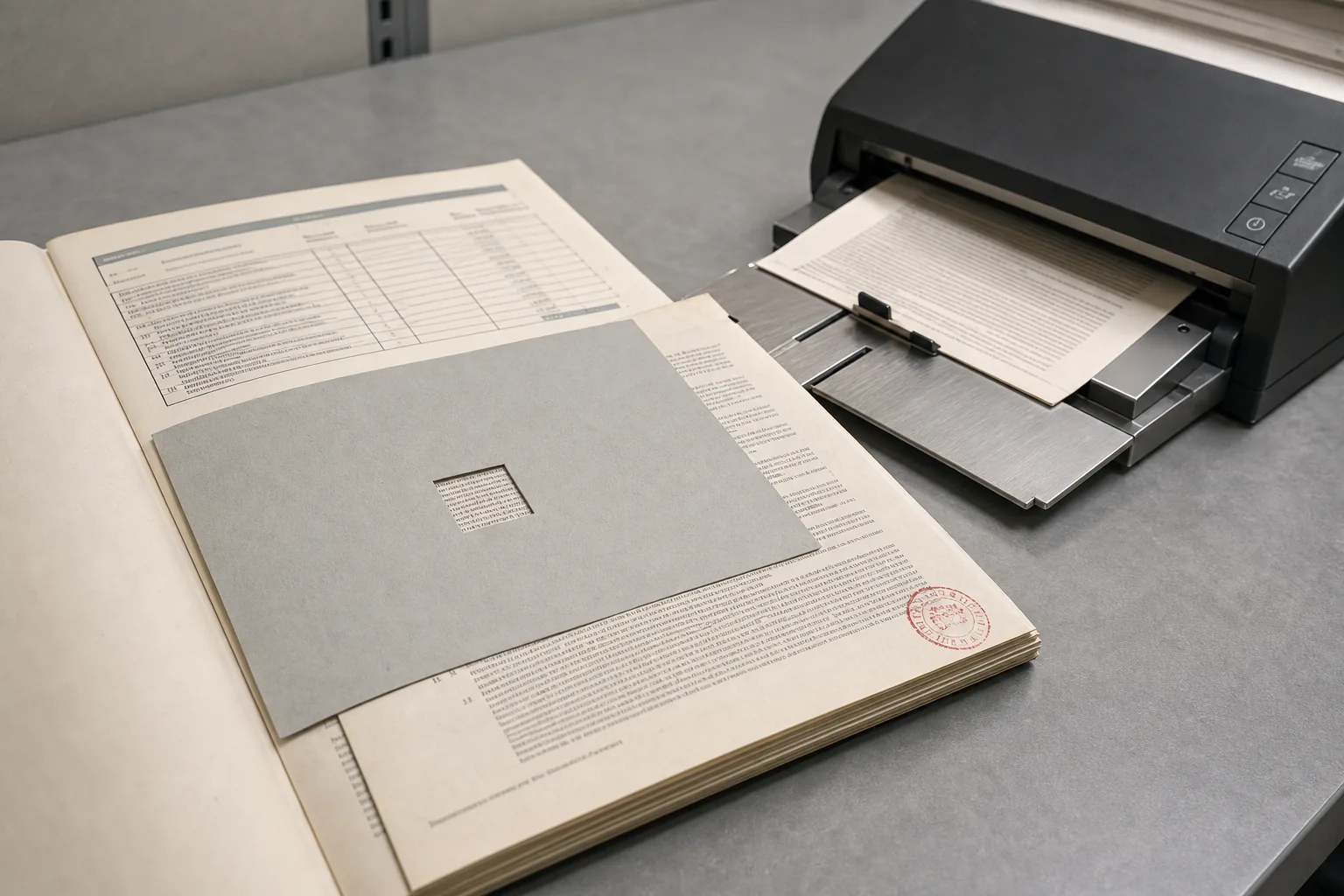
We treat the form number in a footer as filing furniture.
A label for the printer.
A string that finds a PDF when a broker calls.
That is casual by several orders of magnitude.
The form number and edition marker are part of the primary key for a contractual promise.
The policy administration system executes a promise.
The declarations say which forms attached to a term.
The attached form says what the promise means. The footer tells us which text we have.
Lose the relationship between those three and we haven’t modernised anything.
We have made the evidence easier to browse. The distinction is not academic.
CG 00 01 12 07 and CG 00 01 04 13 share a number, a broad purpose, and most of their text.
They are still different contracts.
A loss in 2015 is answered by the edition that attached in 2015. Not by the version now sitting in a shared drive. The two digits at the end are not metadata. They are the difference between evidence and a plausible guess. Which is why I wouldn’t start this work with document management, OCR, or a taxonomy workshop.
All useful later.
First build the control record.
It has to establish, term by term, which edition attached, what it modified, why it attached, and whether it narrowed or broadened the promise. Search without lineage is a polished form of ignorance.
The policy carries more than one stream of evidence
The declarations page is not a coverage form.
It carries named insureds, limits, deductibles, effective dates, and the schedule of attached forms. It is still the authoritative record of what this insured bought for this term. Treat the declarations as a cover sheet and we will get claims answers wrong before reaching the insuring agreement. The attached wording is a different kind of evidence. It holds the grant, the definitions, the exclusions, the write-backs, and the conditions. The IBC 2100 general liability wording is a market reference point in Canada. Our actual wording may be a recognisable departure from it, with a provincial amendatory endorsement or a manuscript change.
The administration system needs the exact attached text. The reader needs a controlled route back.
Then there is the footer.
It is authoritative for identity, edition, and page count.
It is authoritative for nothing else.
A footer can’t say whether the form was mandatory.
Whether its schedule blanks were populated. What changed from its predecessor.
Whether it was permitted for the jurisdiction.
A record designed around the PDF alone confuses the source of identity with the source of operational truth.
The sources disagree in regular ways.
The declarations schedule may list CG 00 01 without the edition suffix. A document stream may attach an endorsement the schedule omits. A page marked Page 1 of 3 may stop at page two. A mandatory amendatory endorsement can be paired with a base edition it was never written against.
Those are not scanning defects.
They are issuance defects with a document-shaped symptom.
The audit is correspondingly plain.
Pull the schedule. Pull every attached document. Compare three things. Every listed form is attached. Every attached form is listed. Each footer edition matches the schedule. Then add schedule blanks, page counts, and jurisdictional dependencies to the exception queue.
Not a glamorous control.
Better than a glamorous control, because it tells somebody before a claim does that a policy packet cannot prove itself.
Editions are events, and versioning them as versions loses the history
A forms library needs an identity rule without sentiment.
Number plus edition marker is one inseparable key.
Cosmetic reissues stay one member where the text hasn’t changed.
Changed wording is a separate member.
Treat every reissue as new and we create noise. Treat changed text as a version of the same thing and we delete the history that matters. The real question is never which edition is current.
It is which edition attached to which term.
A long-tail liability claim can turn on wording withdrawn in the 1970s. A library holding only a current form cannot answer a coverage question about a 2014 policy year. Not even if every page in the repository is beautifully searchable.
Each edition needs a lineage record.
Supersedes. Superseded by. Withdrawn on. Relationship to a base form. It also needs a coverage-effect classification: broadening, restrictive, or neutral against the prior edition. The revision circular or filing memorandum is where that change is stated.
Miss it when the form arrives and somebody later has to diff legal wording by hand, then persuade a claims or compliance colleague that the result is complete.
That classification is not editorial commentary.
A renewal can carry the same base form number while the edition suffix moves.
Several jurisdictions want advance notice where renewal terms narrow.
The control record has to expose a restrictive change as an issuance and compliance event.
Not leave it to a reader who happens to notice two changed characters in a footer.
Canada makes the library considerably less forgiving
Canada gives us no single public form trail.
Automobile insurance is the closed side.
Ontario’s OAP 1 and OPCF endorsements are approved by FSRA.
SPF and SEF families operate elsewhere.
An insurer wanting different automobile wording needs an approved variation, not a quiet redraft.
Commercial property and liability are the open side.
They are generally not filed in Canada, even where conventions like IBC 2100 are widely used.
Quebec publishes its approved automobile materials.
For most Canadian commercial forms, no public record exists.
A form library cannot outsource its provenance to a regulator’s website, because the website has nothing to say.
The provincial layer stays a separate relationship too.
Not as a note on a base form.
Statutory conditions are legislation reproduced inside certain policies.
We may broaden them. We generally may not narrow them.
In Quebec the Civil Code of Québec governs insurance contracts rather than the statutory-conditions regime.
A record marking a wording “Canadian” has hidden a decision.
Language makes the same point more quietly.
English and French texts can share one form number and diverge, because they were translated rather than jointly drafted.
In Quebec the French text ordinarily has priority.
They aren’t one form with a language attribute.
For coverage control they are two records whose lineage has to stay in step.
Alongside any Quebec endorsement overwriting the base wording.
The system is executing a document it may not actually possess
This is where policy anatomy meets technology operations.
The declarations schedule establishes the forms in force.
An endorsement, being later and more specific, overrides the base form it amends.
Negotiated manuscript wording controls over pre-printed text.
Definitions operate everywhere the defined term appears.
Our system may not render all of that at transaction time.
It must not behave as though they don’t exist.
Take the familiar additional-insured question.
An ACORD 25 certificate says it confers no rights and does not amend the policy.
Status comes from the endorsement, the CG 20 10 and CG 20 37 families among them, if it attached.
The difference between a certificate image and an attachment record is not a records-management nicety.
It is the difference between reporting a statement and proving a contractual right.
The same discipline covers claim-time conditions.
Statutory conditions displace inconsistent wording in common-law provinces.
In Ontario auto, the coverage question is often which OPCF endorsement appears on the declarations.
Not a free-form argument about the base policy.
A library joining statutory text, base form, amendatory endorsement, and term-level schedule can support that work.
One holding them in indistinct folders sends the hard question to whoever remembers the old process.
There is a legal reason to be exact.
In Progressive Homes Ltd v Lombard General Insurance Co, the Supreme Court of Canada set out the familiar sequence.
The insured establishes the grant. We establish an exclusion. The insured establishes a carve-back.
The result can turn on the third sentence of a form, a definition altered by an endorsement, or a statutory term we did not draft.
“The system found the latest PDF” doesn’t help that analysis.
Build the control record before anybody builds the repository
The first deliverable is an edition-and-attachment control record.
Not a universal content store.
It carries the combined identity key, printed title, issuer, role, base-form dependency, required schedule fields, attachment rule, jurisdiction applicability, language, lineage, coverage effect, and source provenance.
It records occurrence or claims-made.
The retroactive date belongs on the declarations as policy data, not in the form identity.
It also makes the seams visible.
Policy administration is authoritative for attachment logic, print sequence, permitted issue window, and merge fields.
The declarations are authoritative for what attached here.
The footer is authoritative for the edition printed.
The revision material explains what changed.
The record picks no winner among them.
It gives each source a question it can answer.
So our first acquisition may be an interview rather than a platform.
Somebody still knows why a product code mapped to a dead endorsement.
Why an old Quebec packet printed two texts.
Why a renewal job carried an obsolete edition.
Capture that while it can still be checked against forms, schedules, and system behaviour.
Once it becomes a story about a system that used to work, the control has already failed.
AI makes the archaeology faster, and it should.
It extracts footer values, compares editions, finds apparent missing attachments, and surfaces a form number buried in a scanned renewal package.
It should not decide whether an alteration is restrictive, whether a statutory condition controls, or whether an attachment proves delivery.
Those determinations have contractual consequences.
AI can help us understand the promise.
It doesn’t get to improvise it.
The board conversation is about optionality.
Our task is proof.
A migration, a renewal change, or a claims answer stays defensible when we can show the declarations schedule, the attached wording, the footer edition, and the statutory overlay as one controlled chain.
The risk was never unreadable documents.
It is being unable to prove the contract we issued.
A useful forms library does not store wording.
It preserves the promise attached to a term.
What the issue establishes
- A form number and its edition marker form one identity key for a contractual wording.
- The declarations schedule proves what attached to a policy term, while the attached form supplies the operative wording.
- A form record must classify each changed edition as broadening, restrictive, or neutral relative to its predecessor.
- A control must reconcile listed forms, attached forms, and footer editions, including incomplete pages and schedule blanks.
- Statutory and provincial amendatory wording must be recorded separately from a base form, including French and English Quebec records.
- Canadian commercial forms usually lack a public filing trail, whereas provincial automobile forms are approved and controlled separately.
The unfashionable recommendation
Do not begin with enterprise document management or OCR; first build an edition-and-attachment control record, because searchable documents without contract lineage make a polished form of ignorance.
Asked in the meeting
- Why is the form number not enough to identify a policy wording?
- A policy form is identified by its form number and edition marker together. CG 00 01 12 07 and CG 00 01 04 13 share a number and purpose, but they are different contractual texts. A policy responding to a loss is governed by the edition attached for that term, not by the current version in a forms catalogue.
- What does the declarations schedule actually prove?
- The declarations schedule of forms and endorsements is the authoritative record of what attached to a particular policy term. It identifies the wordings bought with the policy, while the declarations also establish named insureds, limits, deductibles, and the policy period. A broker summary or renewal proposal does not replace that evidence.
- What happens when a form is listed but the policy packet does not contain it?
- The policy has an attachment discrepancy. The forms schedule and the document stream are produced by different processes, so a listed form can be absent, an attached form can be unlisted, or a correct number can carry the wrong edition. Whether an unissued exclusion is effective turns on delivery rules that vary by jurisdiction, so the discrepancy requires investigation rather than assumption.
- How does a forms library detect the wrong edition of a document?
- A control compares three records for every policy term: the declarations schedule, the attached document set, and the footer printed on each form. It confirms that every listed form is attached, every attachment is listed, and each footer edition matches the schedule. A page label such as Page 1 of 3 also exposes a truncated attachment.
- Why must the library record whether an edition broadens or restricts coverage?
- A changed edition can silently broaden, restrict, or leave coverage unchanged even when the renewal declarations show the same base form number. The revision circular or filing memorandum is the source that explains that effect. Recording the classification supports claims interpretation and identifies renewals where a reduction may require advance written notice.
- Are Canadian policy forms all approved by a regulator?
- No. Provincial automobile forms are approved and controlled by provincial regulators: Ontario uses the OAP 1 and numbered OPCF endorsements, while SPF and SEF families operate elsewhere. Commercial property and liability wordings are generally not filed in Canada, so no public filing record normally proves their lineage. Carrier and broker libraries become essential evidence.
- Why does Quebec need a separate forms record?
- Quebec requires separate treatment because insurance contracts are governed by the Civil Code of Québec rather than the common-law statutory-conditions regime. French and English texts under one form number can differ, and the French text ordinarily has priority in Quebec. A provincial amendatory endorsement can also overwrite the base wording. Each applicable text needs its own controlled record.
- Is a certificate of insurance proof that a party is covered?
- No. An ACORD 25 certificate summarizes coverage in force on its issue date and states that it confers no rights and does not amend the policy. Additional-insured status comes from an endorsement, including forms in the CG 20 10 and CG 20 37 families, not from a name typed onto a certificate.
- What is different about a manuscript endorsement?
- Manuscript wording lacks the ordinary bureau footer, filing trail, and edition control. Its record therefore identifies the drafter, the base form and edition it changes, the redline, its negotiated or library origin, and its precedence against printed wording. Those fields matter because specifically negotiated wording can control over pre-printed text.
- Why cannot a migration simply map a product code to a current form?
- A product code does not prove which wording attached to each historical term. Migration can re-derive schedules from product codes, causing a form without a corresponding code in the new system to fail to attach. It can also substitute a live edition for a retired one. The control objective is term-level contract lineage, not a current catalogue.
- Which source is authoritative for a form's attachment rule and print sequence?
- The policy administration system's forms library is authoritative for operational attachment logic, print sequence, permitted issue window, and schedule merge fields. The form footer proves identity, while the declarations schedule proves what attached to a particular contract. A reliable control record preserves all of these sources rather than asking one source to answer every question.
- What is the practical test for a safe forms migration?
- A safe migration proves that the new environment can identify the exact wording attached to each policy term and apply its relationship to declarations, schedules, endorsements, and statutory text. It tests attachment records and edition identity against actual policy packets. A searchable scan collection cannot prove contractual lineage or demonstrate that the administration system is executing the issued promise.