Issue 9 · Authority boundary
Image Triage Should Not Bury the Fraud Referral
Photo and estimate automation can speed ordinary property files, but an efficient queue is not the same thing as an effective fraud operation. The system must preserve indicators, evidence, and the handoff to an SIU.
One system
adjusters
The other
fraud investigation
Image and estimate triage meets fraud investigation when an ordinary property file contains indicators that require evidence preservation, referral, and a separate SIU authority.
The model that makes a file look routine is most dangerous when routine handling destroys the evidence that would have made it unusual.
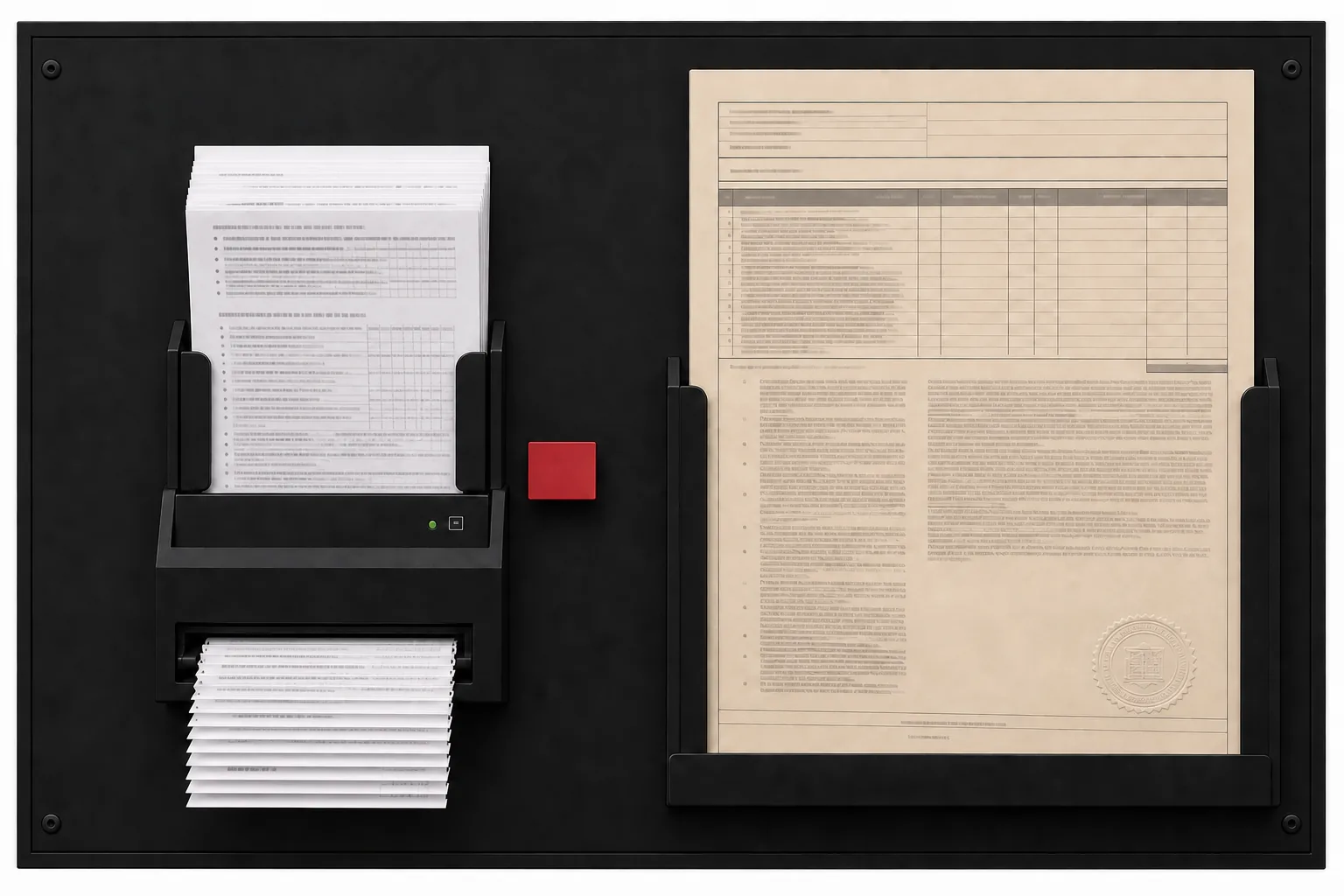
The photograph is not our evidence. It is a pointer to the evidence. We lose that distinction the moment we introduce image triage.
The pitch is persuasive enough.
Read the photographs. Compare an estimate. Clear the ordinary file. Save human attention for exceptions.
On a routine hail claim, sensible.
A roof does not get more damaged because an adjuster waits beside a keyboard.
The model that makes a file look routine is most dangerous when routine handling destroys the evidence that would have made it unusual.
An image classifier ranks a file for us.
It can’t decide the file stopped being desk adjusting and became evidence preservation. That decision sits at the seam between claims and fraud investigation. Design the seam as a queue to minimise, and the system will optimise the referral away.
So here is the limit I would hold.
Photo and estimate automation may accelerate a scope.
It must not overwrite the inspection record.
It must not flatten a referral reason into a score. And it must not let a quick payment path extinguish the materials an SIU would need.
An ordinary property file already has several authorities
We start with the file automation hopes to simplify.
At first notice we take policy number, date and time of loss, cause code, habitability, mitigation, and whether a contractor is already on site.
We set a formula reserve.
Average severity for the peril and region, not an estimate of this loss. We confirm coverage before dispatch: policy in force, deductible, and whether the roof is replacement cost, actual cash value, or a schedule.
Not a generic intake bundle.
A contractor already on site means somebody proposed a scope before we saw the roof. A punctured roof with active leaking goes to same-day mitigation.
An intact envelope is a different path entirely.
A system treating both as a set of photographs threw away the first routing decision.
Catastrophe operations make our boundary clearer.
Staff adjusters saturate within two days of a real event. We assign field work to independent firms by task: inspect, scope, estimate, report.
The staff examiner keeps coverage and cheque-writing authority.
The independent adjuster neither approves nor denies, however complete the photographs look.
The capacity numbers explain why image triage appeals.
A daily-claims adjuster carries forty to eighty files.
A deployed catastrophe adjuster carries several hundred.
First contact is due a day or two after assignment. Physical inspection in a large hail event may be two to six weeks away. Provincial regulators issue temporary certificates in declared catastrophes, so adjusters from elsewhere can work the loss.
That is surge capacity we borrow.
It is not delegated claims authority.
Public adjusters matter for a different reason.
The policyholder pays them, usually a share of the recovery.
Their presence is not an indicator we should act on.
But treat a contractor estimate, a public-adjuster submission, and our own scope as interchangeable uploads, and no later reader knows who produced what, or why.
The examiner’s authority returns with the field report.
The formula reserve becomes a case reserve.
Payments past the examiner’s authority go to a supervisor, a large-loss unit, or reinsurance. A contractor estimate at twice ours produces a supplement, a desk comparison, often a re-inspection. The first payment under replacement-cost coverage is actual cash value: replacement cost less depreciation and deductible.
Nothing there makes a suspicious file proven.
Each creates a version of the file we have to preserve rather than quietly consolidate.
The inspection is not merely training data
On a hail file the adjuster examines each roof slope, because hail is directional. The inspection holds a ten-by-ten test square, a count of fractured mats and bruises, chalk on the hits, and photographs of both the marked square and the identifiable slope.
Repair-versus-replacement thresholds vary by insurer and region.
A visual conclusion cannot replace the record.
Soft-metal damage corroborates. It is not scenery.
Dents in gutter aprons, vents, fascia, screens, condenser fins: they show stones capable of bruising asphalt fell, and from where. The absence of soft-metal damage is the strongest argument against hail on an aged roof. Granule loss and thermal cracking fool an inexperienced observer. The scope becomes a line-item estimate against monthly regional prices. The estimate can hold matching of dissimilar materials, steep-roof charges, by-law work, debris removal, detach-and-reset.
Interior damage carries its own moisture readings.
Scope, photographs, readings, images, estimate versions: a sequence.
Not a bundle to reduce to one total.
The design requirement is concrete.
Preserve the original image, the inspection context, the machine output and version, the human changes, the scope, and the referral indicator, in one sequence.
The corpus prescribes no particular storage architecture.
It makes the consequence plain enough.
The adjuster’s diary entries, photographs, scope, estimate versions, and correspondence are written for somebody who wasn’t there.
An auditor. A market-conduct examiner. Opposing counsel.
Referral is a change of authority, not a bad score
Our fraud flow starts after an ordinary claim opens. Detection arrives through adjuster judgment against a red-flag list, a score at notice, or link analysis across shared attributes. A phone number. A tow operator. A treating clinic. A body shop. A settlement bank account. A witness who keeps reappearing. Image triage is one more source of an indicator.
It is not a conclusion our SIU has reached.
The referral is a form, not a phone call.
“Claimant seemed evasive” gives an investigator nothing.
“Policy bound eleven days before the loss; three contents items lack purchase proof; insured declined to name the retailer” is a scope somebody can check.
Our SIU accepts or declines.
A declined referral returns with a recorded reason, because decline patterns show whether the indicators drifted.
Acceptance changes handling, not the duty to handle.
The adjuster issues a reservation of rights to preserve coverage defences, and keeps adjusting the claim. An SIU file that freezes ordinary handling creates delay and bad-faith exposure.
Which is a useful test for automation.
The system preserves a referral without turning its status into an instruction to stop. The SIU rebuilds the file before any field work. Application and underwriting notes. Payment and endorsement history. Prior claims. Loss date against inception. Last premium payment. Any recent limit increase or rider. CANATICS exposes claims connections across member insurers that one carrier cannot see. Registry, public-body, and open-source searches narrow the next step.
What the image process saw is useful only while its origin survives inside that record.
Privacy is an operating constraint, not legal trim.
Federal privacy law permits collection without consent where consent would compromise an investigation into a breach of agreement.
Quebec adds obligations, and two provinces have their own statutes.
The file records the purpose test before collection.
Open-source material is captured with visible URL and timestamp, preserved, logged with collector and time.
A screenshot in an email is poor material at examination.
Preserve the contradiction before the repair changes it
The field sequence exists to not spend the contradiction early.
A recorded statement usually comes before confrontation.
Loss narrative, whereabouts, ownership, purchase, prior damage, finances: taken while the account is still theirs.
Physical evidence follows, and we hold it.
Every exhibit gets a continuity record from collection.
On a property file that order is blunt.
Where destructive testing is contemplated, every interested party is invited to a joint examination first.
If we proceed alone, that is spoliation.
A repair workflow that discards the original images, substitutes a revised scope, or authorises irreversible work before anybody assesses the referral will get a brisk queue.
It will lose us the case.
The same discipline governs formal demands.
A sworn proof of loss is a statutory condition here.
We may demand documents and signed authorisations.
An examination under oath is contractual and pre-litigation, distinct from discovery.
It locks the claimant into dates, amounts, and names before we disclose contradictions.
An examination that opens with the contradiction gets an explanation instead of an admission.
The final position has an elements test.
The file maps false statement, materiality, knowledge, and timing to named exhibits.
Underwriting guidance in force on the application date says whether the true facts would have changed the decision, the premium, or the payment.
Application misrepresentation supports rescission from inception.
Post-loss fraud engages forfeiture of the claim.
F.H. v. McDougall applies the balance of probabilities while demanding evidence that is clear, convincing, and cogent.
An image score is not an exhibit we can file.
Not every image discrepancy deserves an escalation.
Fraud is a rare-event problem.
Confirmed fraudulent claims are low single digits of most books.
It means we need a referral path that keeps a material discrepancy, says why it mattered, and lets the SIU decline it.
A low review rate isn’t proof of a good threshold.
It may be proof the model learned our capacity limit rather than the risk.
Ask for the loss we did not create
The board opens with cycle time, handling cost, estimates cleared without a visit.
We should bring a second result.
The rate at which viable indicators were preserved, referred, and disposed of on evidence that supports the decision.
That needs separate instruments.
The chain is scored claims, alerts, referrals accepted, findings.
Conversion, acceptance, and substantiation reveal different things.
Substantiation rate alone is not comparable between insurers.
A unit taking only strong files looks excellent by declining work.
On an image model, ROC area flatters under class imbalance.
Precision at k, k being investigator capacity, and lift over random selection answer the useful question.
Did the ranking improve the queue we could staff?
An improvement below that cutoff improved nothing operationally.
The model also faces selective labels.
Its outcomes exist only for claims the SIU investigated, so retraining teaches it to repeat our past choices rather than find fraud.
Our savings number needs its own suspicion.
Demand basis uses the claimed amount. Reserve basis uses the case reserve at referral. Modelled basis uses an expected payout.
Reserve basis is common, and it moves with practice.
Raise reserves at referral and savings rise without a finding.
So whoever pays signs off the savings.
Recoveries stay separate from payments avoided.
A reversed denial reverses the saving that period.
Otherwise the graph rises because we forbade ourselves to learn.
The scorecard also carries the harm.
Report median and ninetieth-percentile days to SIU decision too.
FSRA and the AMF administer rules on handling delay.
Track litigated denials, and how many settle above the denied amount.
A random closed-file audit measures leakage outside the pipeline.
A control holdout is cleaner and harder to defend, because it exempts claims from scoring.
Finally, separate an adverse outcome from a fraud finding.
A claimant who walks away once an examination is scheduled hasn’t necessarily committed fraud.
A denial resolves the contract.
Criminal referral, regulatory referral, FINTRAC, civil recovery: different consequences.
Criminal referral runs to another bar: proof beyond a reasonable doubt, on an offence with its own value threshold.
The SIU should not be asked to make all of those decisions under the label “flag.”
Image triage is valuable when it lightens routine work.
It turns dangerous when routine erases the question of whether the file was routine.
What the issue establishes
- A staff examiner retains coverage and payment authority while an independent catastrophe adjuster works under a discrete task assignment.
- Property-image triage must preserve the original inspection record, test-square evidence, estimate versions, and referral indicators before ordinary claim progression changes the file.
- An accepted SIU referral does not freeze adjusting; the adjuster continues handling the claim while a reservation of rights preserves coverage defences.
- Fraud referral, claim denial, criminal referral, regulatory referral, and financial-intelligence reporting are separate decisions with different authorities and outcomes.
- Fraud operations measure accepted-referral outcomes, evidence sufficiency, reversals, and claimant delay rather than only alerts, queue speed, or reported savings.
- Savings require a declared counterfactual, payment-authority sign-off, separate recovery reporting, and reversal when a denial is later overturned.
The unfashionable recommendation
Optimize for explainable referral yield, not the lowest manual-review rate; an SIU queue is a control surface, not a backlog to be eliminated.
Asked in the meeting
- Who is still in charge when a catastrophe adjuster inspects a property claim?
- The staff examiner retains the coverage decision and payment authority. An independent catastrophe adjuster receives a task assignment to inspect, scope, estimate, and report while the insurer keeps the file. The assignment is a defined piece of adjustment work, not a transfer of the claim. A field report can support the decision, but it does not turn the field adjuster into the person who approves or denies coverage.
- Why can a fast property-photo process create a fraud problem?
- A fast photo process can classify a claim as routine before it preserves the details needed to challenge that conclusion. On a hail file, the marked test square, slope identification, chalked hits, soft-metal evidence, original photographs, scope, and estimate versions establish what the adjuster actually observed. If routine handling replaces or compresses those records, an SIU later receives a conclusion without the evidence needed to test it.
- What should a referral to the SIU actually say?
- A referral states observable facts and identifies the records that support them. It can specify policy inception relative to the loss date, unsupported claimed items, a declined request for retailer information, inconsistent damage evidence, or a connection to shared claim attributes. A statement that a claimant appeared evasive does not define an investigative scope. The SIU accepts or declines the referral, and the reason for a decline remains on the file.
- Does an SIU referral stop the insurer from handling the claim?
- No. The adjuster continues the normal adjustment while the SIU investigates. On acceptance, the adjuster may issue a reservation of rights so the insurer preserves coverage defences while continuing to handle the claim. Freezing the file turns an investigation into unreasonable delay and can create bad-faith exposure. The fraud inquiry and the ordinary claim-handling obligation run in parallel rather than one replacing the other.
- What evidence has to be preserved before a property file goes to fraud investigation?
- The file preserves dated diary entries, original photographs, the written scope, successive estimate versions, correspondence, inspection notes, and the source of each referral indicator. Physical evidence receives a continuity record from collection onward. Before destructive testing, every interested party is invited to a joint scene examination. Proceeding alone can create spoliation, which can damage the insurer's position more than the test helps it.
- Can an investigator collect information without telling the claimant?
- Federal private-sector privacy law permits collection without knowledge or consent when consent would compromise an investigation into a breach of an agreement. Quebec has additional private-sector obligations, and Alberta and British Columbia have their own statutes. The file records the purpose test before each collection. Open-source material is captured with the visible URL and timestamp, the page is preserved, and the collector and collection time are logged.
- Is denying a claim the same thing as referring someone for fraud?
- No. A denial resolves the insurance contract and states grounds such as material misrepresentation, a wilfully false proof of loss, non-cooperation, or breach of a statutory condition. A referral seeks a separate consequence. Criminal matters go to police or the Crown, licensed intermediaries can go to a provincial regulator, some life and annuity activity goes to FINTRAC, and paid amounts may support a civil recovery.
- What does a fraud file need before a denial can hold up?
- A defensible file maps each element of the intended position to a named exhibit. It identifies the false statement or omission, shows materiality through underwriting guidance or payment evidence, records knowledge or wilfulness where required, and distinguishes application-stage misrepresentation from post-loss fraud. Canadian civil cases apply the balance of probabilities, while criminal referral engages proof beyond a reasonable doubt and the Criminal Code fraud threshold at $5,000.
- Why is the lowest manual-review rate not a good fraud metric?
- Fraud is a rare-event problem, so reducing manual review can simply remove the files that would have produced usable referrals. The operational chain is scored claims, alerts, accepted SIU referrals, and substantiated findings. Useful measures include alert-to-referral conversion, referral acceptance, substantiation, precision at the alert volume the unit can staff, and lift over random selection. Queue speed alone says nothing about whether evidence survived.
- What does a reported fraud saving actually mean?
- A fraud saving is the difference between a counterfactual payment and the amount actually paid. Demand basis uses the amount claimed, reserve basis uses the case reserve at referral, and modelled basis uses comparable claims. Reserve basis is common but can rise when reserving changes rather than when investigations improve. Payment authority signs off the saving, recoveries are reported separately, and a reversed denial reverses the saving when the reversal occurs.
- How should management measure whether an SIU is harming legitimate claimants?
- Management reports the median and 90th-percentile days from referral to SIU decision alongside savings and referral outcomes. FSRA in Ontario and the AMF in Quebec administer conduct rules that reach unreasonable claim-handling delay. The report also tracks litigated denials and the share later reversed or settled above the denied amount. A fraud program cannot treat claimant delay as somebody else's operating measure.
- Why is an abandoned claim not proof of fraud?
- Abandonment means the claimant stops responding after an examination under oath is scheduled or after records are requested. It is a common favourable outcome in personal lines, but no tribunal has necessarily decided that the claim was fraudulent. A legitimate claimant may also abandon a claim because the process becomes difficult. The closure code therefore records an outcome, not a proven accusation.